
Download and print our free domino PDFs to create a simple game for use at home, in educational settings or while travelling. The collection currently includes traditional dominoes with dots and an easy-to-read version with numbers. Additional printable domino sets and related activities may be added in the future.

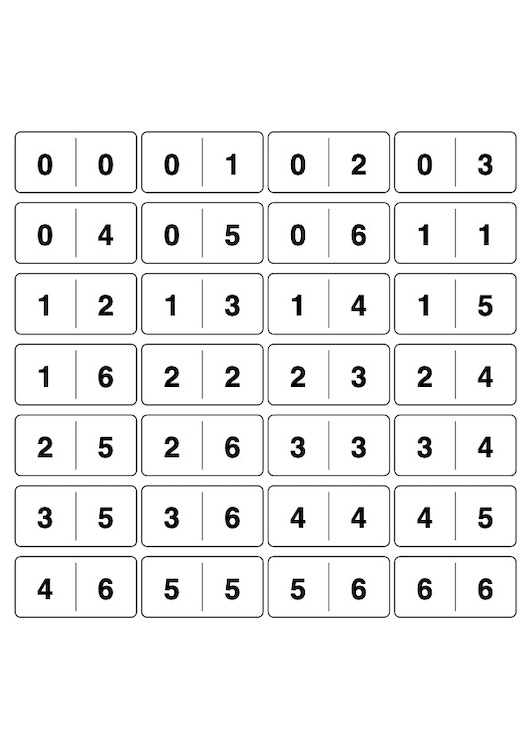
Free Dominoes to Print and Use
Printable dominoes offer a convenient alternative to purchasing a physical set. After downloading the preferred PDF, print the page and cut out the 28 tiles by following the outlines. Each set includes every combination from 0–0 to 6–6, making it equivalent to a traditional double-six domino set.
For stronger and more durable pieces, print the page on cardstock or attach it to thin cardboard before cutting. Laminating the sheet can provide additional protection and make the surfaces easier to clean. Ordinary printer paper can also be used for a temporary set, although the pieces may be easier to handle if the paper is folded, mounted or reinforced.
Select “Actual size” or 100% scale in the printer settings to preserve the intended dimensions of the dominoes. After use, the finished pieces can be kept together in an envelope, small box or reusable storage bag.
Choose Between Dots and Numbers
The traditional version uses familiar dot patterns. This design resembles a standard set of dominoes and can be used for classic games, counting exercises and visual matching activities.
The alternative version displays digits instead of dots. Numbered dominoes may be useful for beginners or for adults preparing activities that focus on number recognition and matching. Both printable versions contain the same 28 combinations and follow the same basic rules.
Parents, teachers and other educators can also use the two sets together. For example, a player can match a tile showing five dots with a tile displaying the number 5. This creates a simple activity connecting written numerals with visual quantities.
How to Play a Basic Game of Dominoes
Place all 28 tiles face down on a flat surface and mix them together. The face-down tiles form the draw pile, which is also commonly called the boneyard. Each player then takes an agreed number of tiles without revealing them to the other participants. Seven tiles per player is suitable for a basic two-player game. When more people are taking part, fewer tiles may be dealt to each player.
A common way to begin is for the participant holding the highest double, usually 6–6, to place it in the centre. If nobody has a double, the highest-value available tile can be used to start the game.
Players take turns placing one domino at either open end of the chain. One side of the new domino must have the same value as the exposed end. For example, a 3–5 tile can be placed beside an open 3 or an open 5.
If a participant cannot make a match, they draw a tile from the face-down pile. Depending on the rules agreed before the game, they may continue drawing until they find a playable tile or draw once and then pass.
The first participant to place all their dominoes wins the round. If no further moves are possible, the round is considered blocked. In that situation, the participant with the lowest combined value on their remaining tiles is usually declared the winner.
Other Uses for Printable Dominoes
These printable tiles can also be incorporated into activities prepared by parents, teachers, homeschooling adults or activity leaders. Possible uses include sorting tiles by value, identifying doubles, matching equal numbers and practising simple addition.
A printable set can be useful for family game nights, classroom activity stations, indoor recreation, holiday gatherings and travel. The rules can be simplified or adjusted according to the setting, making dominoes a flexible activity for different ages and levels of experience.